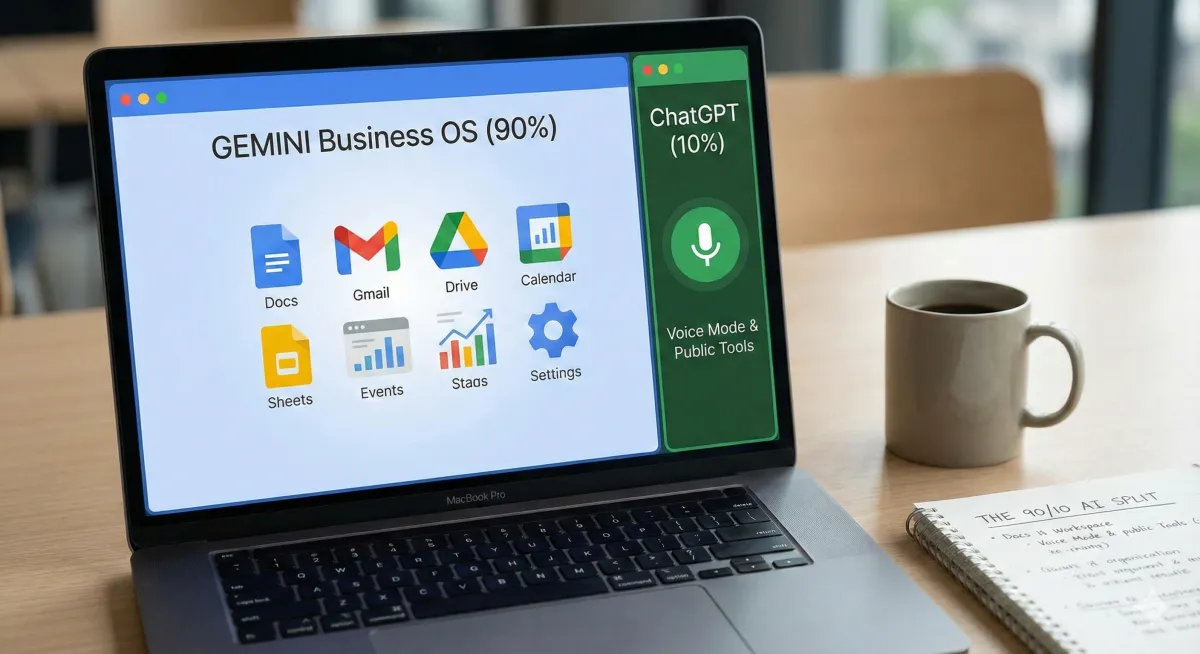
The 90/10 Split: Why I Moved My Business to Gemini (And the Surprising Things I Still Use ChatGPT For)
Introduction: Beyond the Hype
For the last couple of years, the noise around AI has been deafening. Every guru, every course, every LinkedIn post promises that AI will revolutionize your workflow and change the very nature of how you do business. But when you actually try to integrate these tools into a real, working day? The reality is often miles away from the hype. The experience feels clunky, disconnected, and sometimes like more effort than it's worth.
To give you some context, I'm not new to this game. I've been a dedicated Google Workspace user for 16 years. My entire business lives in that ecosystem: documents, client communications, strategy sessions, everything. So believe me when I say, I wanted to love Gemini from day one. I was rooting for it. But for a long time, it just wasn't ready.
This article cuts through the noise. It's a practical, behind-the-scenes look at a real-world system I've developed after a year of trial, error, and genuine frustration. This is the story of my journey from 100% reliance on ChatGPT to a new, battle-tested 90/10 split. This isn't just about better prompting; it's about building a true operational core for a business that actually works.
The Big Shift: Gemini as a Business "Operating System"
To understand why this 90/10 split is so effective, you have to understand the evolution that led to it.
A year ago, during what I now call the "Dark Ages" of my AI workflow, I was 100% reliant on ChatGPT. I kept trying to bring Gemini into the fold because all my data lived in Google Workspace, but it was a complete non-starter. It couldn't reliably access my data, making it a powerful tool that was essentially useless inside my own digital factory.
Then, about six months ago, we hit a turning point. The Workspace integration finally started working as intended. It stopped fighting my infrastructure and started leveraging it. That's when my workflow started to shift, and it shifted fast. I went from 100% ChatGPT to 80/20, then 60/40. The data was overwhelmingly pointing in one direction, leading to today's 90/10 split.
This shift was possible because of a fundamental reframing of what Gemini actually is. To make this system work, you have to stop thinking of it as just another chatbot. You have to start seeing it as a business "Operating System."
Gemini is no longer just a chatbot; it's my Operating System.
The Surprising Tactic: A "Morning Briefing" That Reclaims an Hour
My new daily routine begins with a counter-intuitive step. I don't open my email. I don't check my notifications. I open Gemini.
Every morning at 6:00 AM, a simple, automated prompt runs: 'Review my emails and calendar. Summarize urgent issues and outline my appointments.'
This single prompt saves me an hour of unfocused work every morning. Full stop.
By the time I finish my first coffee, I have a clear, strategic overview of the day ahead. I know exactly where the "fires" are that need my immediate attention and what my schedule holds, all without getting lost in the weeds of my inbox or distracted by newsletters that don't matter. It provides immediate focus and sets the tone for a productive day.
Bonus Tactic: The Automated Content Engine
Beyond daily planning, Gemini has become my systematized content engine. Using custom instructions called "Gems," I've encoded my core business DNA directly into the AI: my content calendar, target topics, and brand voice rules. I no longer just ask for content; I call on my Gems, and Gemini produces on-brand, on-strategy material instantly.
The real game-changer is the seamless visual integration. I can generate a social media post, create three different image options, and have it ready to publish in minutes, all within the same conversation. It's a complete production line in a single window.
The Decisive Advantage: "Live Data" for Deep Research
For deep research and intelligence gathering, Gemini has a fundamental advantage that tools relying on a static database simply cannot match: live data access.
The difference is best described with a metaphor: it's the difference between reading a year-old newspaper and having a live intelligence feed wired directly into your desk.
I discovered this firsthand when I was preparing to sell an investment property. I ran a deep research report through Gemini on the property, and honestly, I was pleasantly surprised by both the accuracy and the depth of what it pulled. It helped me strategize on ways to position the property to get it sold, insights I wouldn't have uncovered through traditional research methods or static AI models.
This is where Gemini has become the most reliable tool I've found for performing live property research. When you need current market data, recent comparable sales, zoning changes, or local development news, Gemini pulls from Google's live index. The quality and timeliness of that data is on another level.
For real estate professionals, this capability is a game-changer. Whether you're researching a listing, preparing a CMA, or advising a client on market positioning, having access to the most current information available makes all the difference.
The Pragmatic 10%: Where ChatGPT Still Wins (and Gemini "Sucks")
Credibility comes from being honest about a tool's shortcomings. This system isn't about blind advocacy; it's about using the right tool for the right job. And for about 10% of my work, ChatGPT remains a crucial, tactical specialist for three key reasons.
First, voice mode. There's no way to put this delicately.
I'm going to be blunt here: Gemini's voice mode absolutely sucks. I can't sugarcoat it.
It's robotic, slow, and the latency makes a natural conversation impossible. In contrast, ChatGPT's Advanced Voice Mode is fluid, conversational, and shockingly human. It has become my go-to brainstorming partner for when I'm away from a screen: walking, driving, or at the gym.
Second is collaboration. When I build and share a custom AI tool with clients or a wider audience, ChatGPT is the path of least resistance. It has the market share, and people are comfortable with its interface. It's a practical business decision to reduce friction for others.
Finally, there's the simple issue of legacy tools. I have old Custom GPTs I built over a year ago that still work perfectly for certain niche tasks. If it ain't broke, I don't fix it.
Your New AI Action Plan
If you, like me, live and breathe in Google Workspace, if your world is Gmail, Drive, and Docs, stop fighting it. The integration is finally ready. It's time to lean in.
To distill this entire strategy into a simple framework, here is a two-part action plan you can implement today:
Use Gemini to do the work. (Docs, Research, Email)
Use ChatGPT to do the talking. (Voice Mode, Public Tools)
Let Gemini be your factory floor; let ChatGPT be your conference room.
The shift to this 90/10 split didn't happen overnight, and it won't be perfect on day one for you either. But if you're serious about building systems that actually scale your business rather than just adding more tools to your tech stack, this is the framework that works.
Ready to dive deeper into AI tools and strategies that actually move the needle for real estate professionals and entrepreneurs? Join our "Unstuck: AI Tools & Strategies for Real Estate & Entrepreneurs" Facebook group. It's where operators, not spectators, share what's actually working in the field. No hype. No fluff. Just practical systems that scale. Click here to join the conversation.