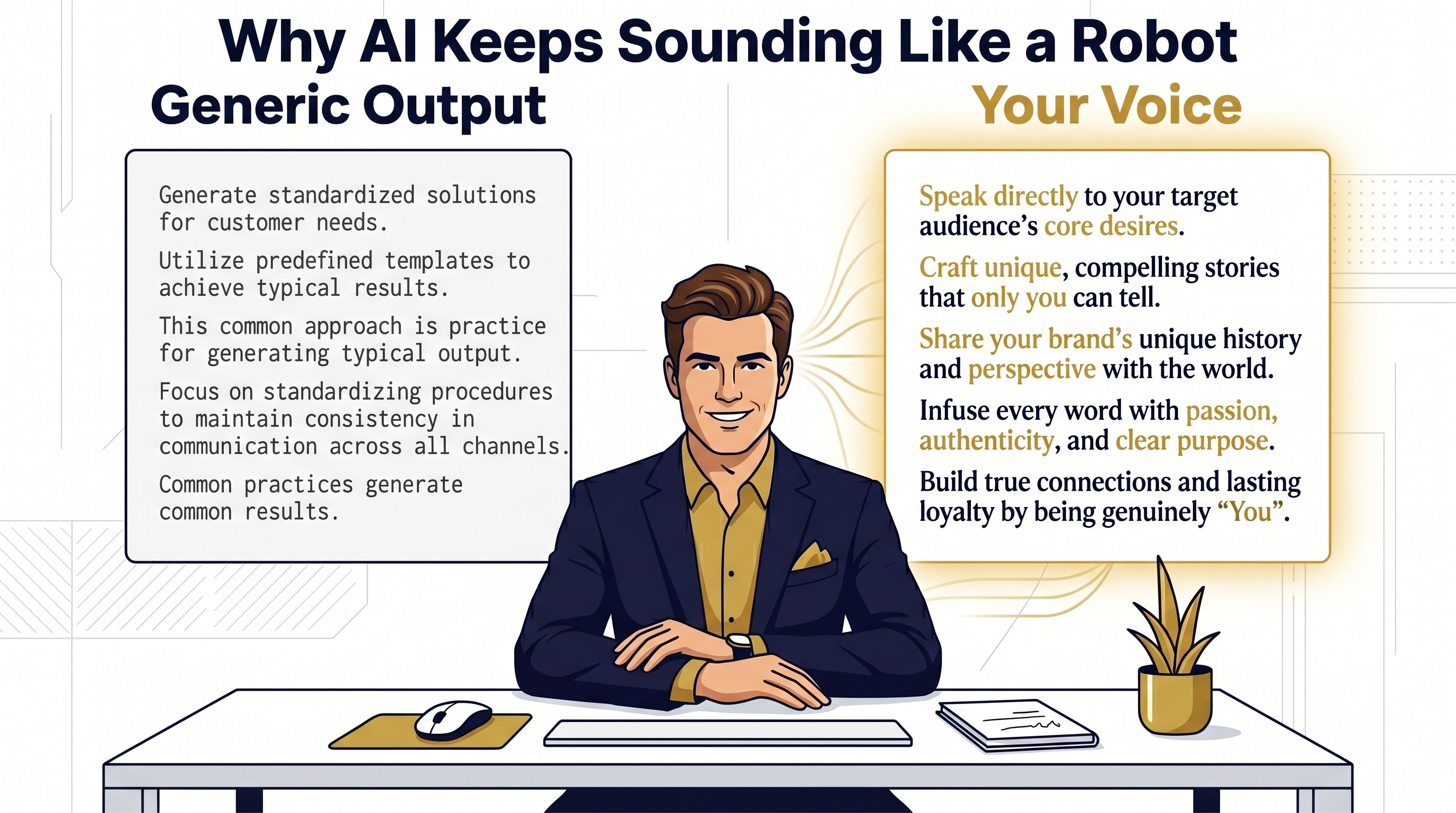
Why AI Keeps Sounding Like a Robot — And the One-Page Fix That Changes Everything
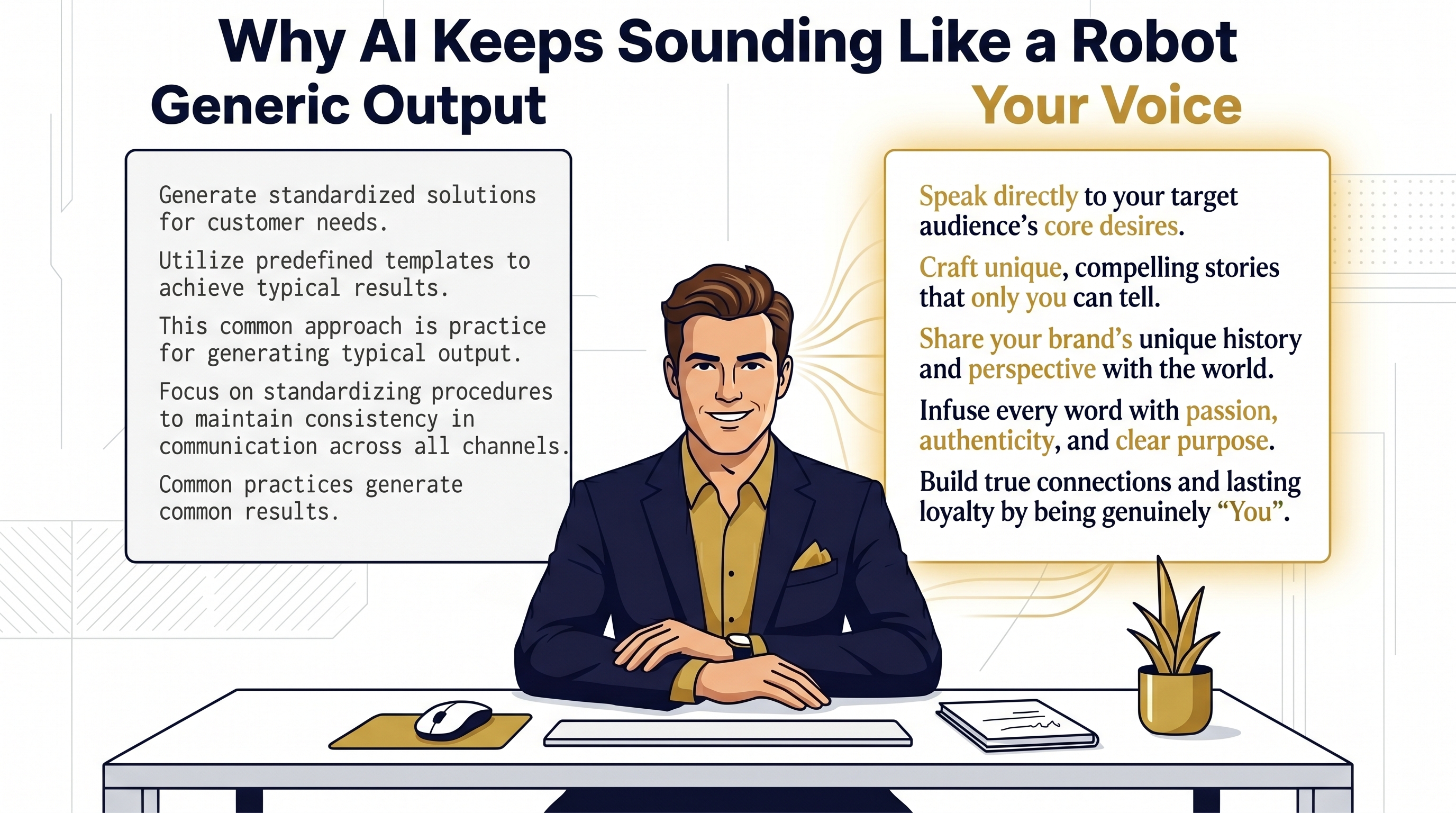
You've tried it. You open the AI tool, type a question, and get back something that technically answers what you asked — but sounds like it was written by someone who has never met a real client, never worked in your market, and definitely doesn't talk the way you do.
So you spend the next 20 minutes editing it back into something human. And at some point you start wondering whether AI is even worth the hassle.
Here's what's actually happening: the AI isn't broken. It's doing exactly what you told it to do. The problem is that you gave it a generic question, so it gave you a generic answer. It doesn't know who you are, who your clients are, what your market looks like, or how you communicate. Every time you open a new chat, it's day one. You're starting from scratch with a stranger.
The fix isn't a better AI tool. It's a better starting point. And it only takes about ten minutes to build.
The Problem with Treating AI Like a Search Engine
Most business owners use AI the same way they use Google — type in a question, get an answer, move on. And for simple lookups, that works fine. But when you're using AI to write client communication, create marketing content, or draft anything that needs to sound like you, that approach falls apart fast.
The output is generic because the input is generic. When you type 'write me a follow-up email for a prospect I met last week,' the AI has no idea who that prospect is, what they care about, what objections they raised, or how you normally communicate with your clients. It fills in the blanks with the most average possible version of everything — and average is exactly what you don't want representing your business.
The real power of AI isn't in the tool itself. It's in the context you give it. And most business owners are skipping that step entirely.
What an Agent AI Brief Actually Is
An Agent AI Brief is a one-page document you build once and reuse everywhere. Think of it as an onboarding document for any AI tool you work with — the equivalent of sitting down with a new team member and walking them through who you are, who your clients are, how you communicate, and what your market looks like.
Once it's built, you paste it at the top of any AI conversation — Claude, ChatGPT, Gemini, whatever you're using — and from that point forward, the AI responds as if it already knows your business. Not a generic version of your business. Your actual business.
The brief covers five things:
Your identity — your name, your role, what you're known for, and what makes your approach different from everyone else doing what you do.
Your clients — who you actually work with, what they're worried about, what objections come up repeatedly, and what they need from you to feel confident moving forward.
Your voice — the phrases you use, the phrases you'd never use, the tone that feels natural to you. This is the piece that makes AI output sound like you instead of a generic bot.
Your market — the local knowledge, context, and nuance that only someone in your world would know. The stuff an AI would never guess, but your clients expect you to already understand.
Your use cases — the specific tasks you'll use AI for most and the questions your clients ask you over and over. Knowing this upfront means the AI is already calibrated for the work you actually need it to do.
The Difference Context Makes
The same question, asked with and without context, produces results so different they barely feel like they came from the same tool.
Without a brief, AI defaults to the safest, most average version of everything. The output is technically correct, polished in a generic way, and completely forgettable. It doesn't sound like you. It doesn't reference anything specific to your clients or your market. And it requires significant editing before you'd feel comfortable sending it.
With a brief, the AI knows enough to write something that actually sounds like it came from you. It uses your language. It references things your clients actually care about. It approaches the situation the way you would approach it — because you told it how you think.
The difference isn't subtle. Most people who try this for the first time are surprised by how dramatically the output quality shifts. Not because the AI got smarter, but because you gave it something real to work with.
Building Your Brief Without Starting from Scratch
The part where most people get stuck is the blank page. You know you need to describe your business, your voice, your clients — but sitting down to write about yourself in the third person for an hour isn't something anyone actually wants to do.
The smarter approach is to let the AI interview you. Instead of writing the brief yourself, you use a structured prompt that walks you through the five categories one question at a time. The AI asks, you answer conversationally, and at the end it compiles everything into a clean, ready-to-use brief.
The whole process takes about ten minutes. You don't need any technical skills. You don't need a special subscription. You just need your AI tool of choice and enough time to answer a few questions about your own business — something you already know the answers to.
When it's done, save the brief somewhere you can access it quickly. A pinned Google Doc works well. The goal is to be able to grab it and paste it in before you start any AI task, without it feeling like extra work.
What You Can Do with It Once It's Built
Once the brief exists, the range of things you can use AI for expands significantly. You're no longer limited to tasks where generic output is acceptable. You can use it for anything that needs to sound like you.
Client follow-up emails. Marketing copy. Social media captions. Proposal language. FAQ responses. Content that explains your process or your value in a way that resonates with your specific audience. Any time you're using AI for written communication, you paste the brief, ask your question, and the output is ready to use — or close enough that the editing is minimal.
For those already comfortable with AI tools, both Claude and ChatGPT allow you to create saved workspaces — a version of the tool that already has your brief loaded before you type a single word. No pasting required. You open your workspace and it already knows who you are. That's a more advanced setup, but even without it, the paste method alone produces a noticeable improvement immediately.
The Real Takeaway
AI gives you generic output because you're giving it generic input. That's the whole problem, and it has a straightforward solution.
An Agent AI Brief is a one-time investment of about ten minutes that changes the quality of every AI interaction you have from that point forward. It doesn't require technical skills, expensive tools, or a major workflow overhaul. It requires knowing your business — which you already do — and giving the AI enough of that knowledge to actually be useful.
Build it once. Paste it every time. The output will sound like you, not a robot.
At Lehman Strategic Partners, we help entrepreneurs and small business owners build the systems and strategies that let them stop reacting and start scaling. If you're ready to stop owning a job and start owning a business, that's exactly what we do. Reach out when you're ready.