Why I Record Every Client Conversation (And Why You Should Too)
Why I Record Every Client Conversation (And Why You Should Too)
Let me be direct: I record every client conversation I have. Every single one.
And before you think this is some covert operation, let me be equally clear: I tell everyone upfront that I'm recording. Full disclosure, every time. It's not negotiable, and it shouldn't be for you either.
Not because I'm paranoid. Not because I don't trust people. But because I've learned the hard way that the best insights, the critical details, and the subtle nuances that transform a transaction into a relationship don't survive the notebook-to-memory transfer.
If you're a real estate agent juggling multiple clients, navigating complex transactions, and trying to build genuine relationships while also running a business, this might be the single most valuable operational change you make in 2026.
The Problem: The Illusion of Good Notes
Here's what used to happen to me, and I see it happen to agents everywhere:
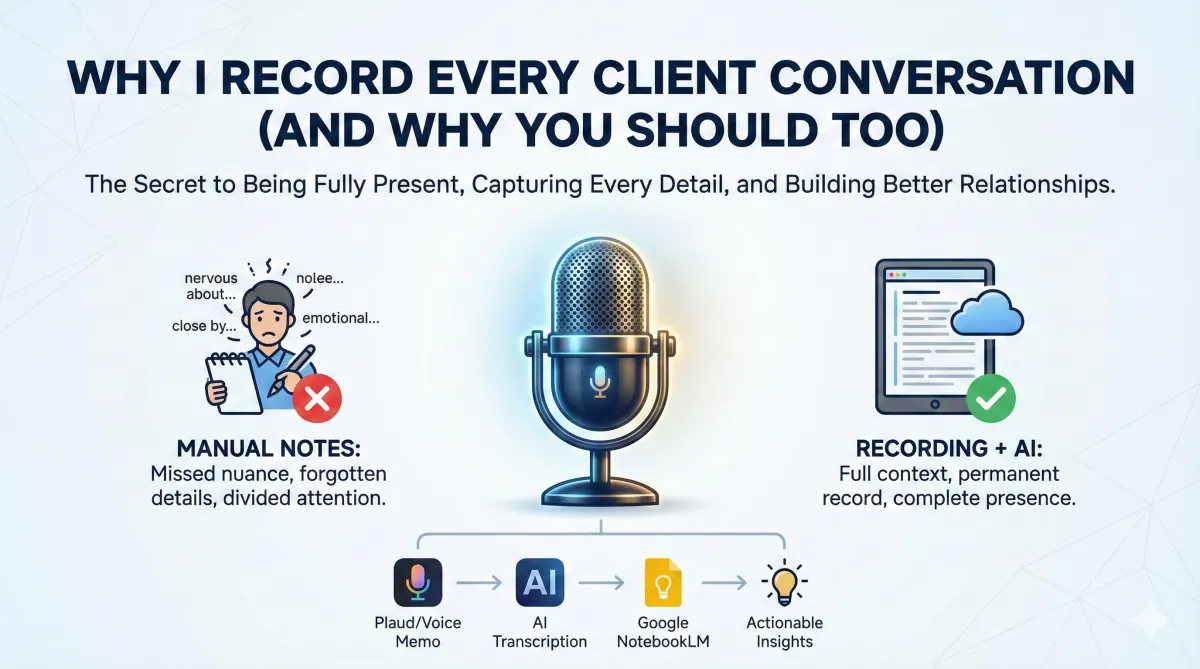
You're sitting across from a client. They're sharing their story. Maybe it's their first home purchase and they're nervous about the inspection process. Maybe they're downsizing after their kids moved out and they're emotional about leaving the family home. Maybe they casually mention they need to close by a specific date because of their daughter's school enrollment.
And you're nodding. Listening. But also frantically scribbling notes.
You write down "nervous about inspection." You jot "emotional about move." You underline "close by Aug 15."
But here's what you miss while you're writing:
The slight catch in their voice when they mentioned their daughter
The specific concern about the age of the HVAC system
The fact that they mentioned their mother might be moving in with them "eventually"
The offhand comment about their budget being tighter than they initially let on
You miss it because you're not fully present. You're performing the theatre of attentiveness while actually being half-engaged, split between listening and documenting.
And then, three weeks later, you review those notes and they're borderline useless. "Emotional about move." Okay, but why? What was the context? "Close by Aug 15." Was that flexible or non-negotiable?
Your notes, which felt comprehensive in the moment, have become vague fragments. The emotional context is gone. The nuance is lost. And you're left guessing about what really matters to your client.
The Agitation: What This Really Costs You
This isn't just an inconvenience. It's a competitive disadvantage that's costing you deals, referrals, and the ability to deliver truly exceptional service.
You're leaving money on the table. When you miss a client's specific concern or goal, you can't address it proactively. That means you're not differentiating yourself from every other agent who's just going through the motions. Your clients don't feel truly understood, because frankly, you don't truly understand them, at least not as well as you could.
You're creating unnecessary stress. Without a complete record, you're constantly second-guessing yourself. Did they say they wanted to see properties on the east side or the west side? Were they flexible on square footage or was 2,000+ sqft non-negotiable? This uncertainty creates friction in every interaction.
You're limiting your team's effectiveness. If you work with a team, your incomplete notes mean your transaction coordinator, your showing assistant, or your admin only get a fraction of the story. They can't anticipate the client's needs because you haven't captured them fully. This breaks down the seamless experience you're trying to create.
You're making the same mistakes twice. Without transcripts, you can't review past conversations to learn from them. You can't identify patterns in your client interactions. You can't refine your intake questions or improve your process because you don't have the raw data to analyze.
And here's the truth that nobody wants to admit: the longer you rely on manual note-taking, the more you're building your business on a foundation of forgotten details and missed opportunities.
The Solution: Record Everything
The answer is simple: record your conversations. All of them.
I know what you're thinking. "Clay, people will feel uncomfortable." "It's too much work." "I don't want to be 'that guy.'"
I used to think the same thing. But here's what I've learned after years of recording every client interaction:
Recording Makes You More Present, Not Less
This was the biggest revelation for me. When I stopped trying to capture every detail in real-time, I became a better listener. I could focus on the conversation itself, on reading the client's body language, asking better follow-up questions, and building genuine rapport.
The recording handles the documentation. I handle the relationship.
You Capture Everything, Not Just What You Think Is Important
Here's the thing about live note-taking: you're making real-time judgments about what matters. And you're often wrong.
That throwaway comment about a client's mother "maybe" moving in? That becomes critically important two months later when they suddenly need to see properties with in-law suites. The casual mention of a job change? That's actually a red flag about financing that you need to address immediately.
With a full transcript, nothing is lost. Every word is preserved. And when you review it later or feed it into AI for analysis, you often discover insights you completely missed in the moment.
Your Notes Become Permanent and Shareable Knowledge
Here's a harsh truth: your handwritten notes become worthless within days. Maybe hours. You forget the context. You can't read your own handwriting. You lose the notebook.
But a transcript is permanent, searchable, and shareable. Your transaction coordinator can read exactly what the client said about their timeline. Your showing assistant can see their specific must-haves and deal-breakers. Your lender can understand the complete financial picture because you can share relevant excerpts.
This transforms your team from people who need constant updates into people who have direct access to the source of truth.
2026 Is the Year Recording Becomes Standard
A few years ago, recording conversations felt intrusive. People pushed back. But the world has changed.
We've all been on a dozen Zoom calls this week. We know Microsoft Teams records meetings. We've seen the "This call may be recorded for quality assurance" message a thousand times. Recording is now normal, expected, and increasingly appreciated, especially when you frame it correctly.
How to Ask Permission Without Being Awkward
This is where most agents get stuck. They know recording is valuable, but they freeze up when it's time to actually ask for permission. Let me give you the exact framework I use that works 99% of the time.
The Key: Frame It as a Benefit to Them
People resist recording when they think it's for your benefit. They embrace it when they understand it's for theirs.
Here's my standard script when scheduling a call or video meeting:
"I record our conversations so I can be fully present with you and make sure I don't miss any details that are important to you. That way I'm not frantically taking notes and can actually focus on what you're telling me. Is that okay with you?"
Notice what this does:
It explains the "why" immediately
It positions the recording as client-focused, not agent-focused
It emphasizes that it helps you serve them better
It asks for permission explicitly
The response is almost always some version of "Oh, of course" or "That makes total sense."
For In-Person Meetings
For face-to-face conversations, I adjust slightly:
"Before we get started, I want to let you know I'm going to record our conversation on my phone. I do this so I can stay focused on you instead of buried in my notepad. I've found clients really appreciate that I can recall every detail they've shared with me, even weeks later. Does that work for you?"
Then I visibly place my phone or recorder on the table between us. This visible cue reinforces the transparency and eliminates any sense of being sneaky.
What If Someone Says No?
In five years of doing this, I've had exactly three people decline. When it happens, I respect it immediately: "No problem at all. I'll take notes the old-fashioned way."
But here's the thing: those three people all came back later and said, "You know, actually, go ahead and record. I see how it helps you remember what I said."
Why? Because in that first conversation, they saw me distracted by note-taking. They experienced the difference between a half-present agent and a fully engaged one. And they made the rational choice.
The "Forgot to Ask" Scenario
Sometimes you're 10 minutes into a conversation and realize you forgot to hit record or ask permission. Don't panic.
Just pause and say: "I want to make sure I'm capturing everything you're sharing with me. Would you mind if I start recording the rest of our conversation? I can summarize what we've covered so far."
The interruption is minor. The benefit is massive. And the client almost always appreciates the professionalism.
Normalize It in Your Intake Process
The best approach? Make recording a standard part of your process from day one.
When a new client signs with you, include it in your welcome packet or onboarding conversation: "As part of how I work, I record all our conversations. This ensures I never miss a detail and can provide you with the most attentive service possible. All recordings are kept confidential and are only used to serve you better."
When it's framed as "this is how I work" rather than a special request, it becomes a non-issue.
How to Implement This in Your Business
Let me give you the practical playbook I use:
1. Choose Your Tools Based on the Situation
For video calls (Zoom, Google Meet): Just hit record. It's built in, it's easy, and the transcription quality is excellent. This should be your default for any remote conversation.
For phone calls: I use Plaud, an AI note-taking device that creates clean transcripts. There are other options like Fireflies.ai or Otter.ai, but find one that works for you and use it consistently.
For in-person conversations: Your iPhone's Voice Memo app works surprisingly well. Yes, the transcript might not perfectly distinguish between speakers, but when you feed it into AI, it can usually piece together who said what based on context.
The key is having a system and sticking to it. Don't let the perfect be the enemy of the good.
2. Feed Everything Into Google NotebookLM
This is where the magic happens.
Google's NotebookLM is a game-changer for extracting insights from your transcripts. You can upload multiple conversation transcripts and ask it questions like:
"What are this client's top three priorities?"
"What concerns have they expressed about the buying process?"
"What's their ideal timeline and how flexible is it?"
"Summarize all the properties they've been interested in and why."
NotebookLM doesn't just regurgitate information. It synthesizes it. It finds patterns. It connects dots you might have missed.
This means you can review weeks of conversations in minutes and show up to your next client interaction with a level of preparation that feels almost unfair.
3. Build a Review Cadence
Here's my process:
Immediately after the conversation: I don't do anything. The recording is safely stored. I'm not frantically cleaning up notes.
Within 24 hours: I review the transcript and use NotebookLM to pull out action items and key insights.
Before the next interaction: I review previous transcripts to remind myself of context and details.
This takes less time than traditional note-taking and produces dramatically better results.
The Bottom Line
Your clients are telling you everything you need to know to serve them exceptionally well. The question is: are you capturing it?
In 2026, recording your conversations isn't optional anymore. It's table stakes for delivering the kind of personalized, attentive service that generates referrals and builds a reputation.
Stop trying to scribble your way to success. Start recording. Start being present. Start building a knowledge base that actually serves you and your clients.
Your clients will thank you for it. And your future self will too.